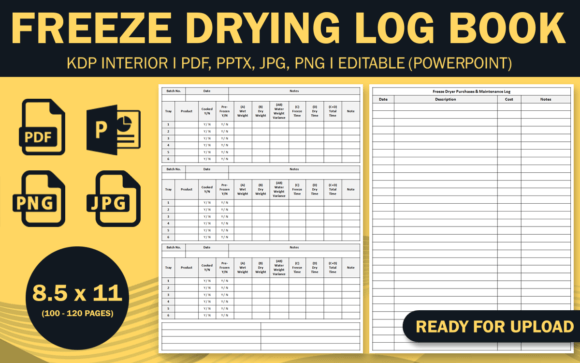
Freeze Drying Log Book
Whether you are preserving seasonal harvests, developing shelf-stable ingredients for a small business, or conducting experiments in a lab, a dedicated log book transforms guesswork into repeatable results. The Freeze Drying Log Book is more than a notebook—it is a structured system for tracking every variable that affects quality, from pre-treatment to final storage. With the included editable source file, multiple PDF interiors, and high-resolution artwork, you can tailor this tool to your exact workflow and even prepare it for print-on-demand platforms like KDP.
Why a Dedicated Freeze Drying Log Book Matters
Freeze drying is a precise process. Small changes in loading temperature, chamber pressure, or drying time can alter the texture, nutrient retention, and rehydration behavior of the final product. Relying on memory or scattered notes leads to inconsistency. A structured log book gives you a single place to record each batch’s parameters, observe patterns, and refine your method over time.
Beyond troubleshooting, a log book serves as a reference library. When you find the perfect cycle for banana slices or ground coffee, you can replicate it exactly. If a batch fails, you have the data to identify what went wrong. For anyone serious about freeze drying—whether for emergency food storage, gourmet camping meals, or ingredient production—consistent documentation is the foundation of mastery.
Who Benefits from a Customizable Log Book
This resource fits a wide range of users. Consider how different roles can apply the templates:
- Home preservers and preppers: Track multiple food types, pre-treatment methods (blanching, slicing, pre-freezing), and storage conditions. Use the journal to build a personal database of optimal cycles for fruits, vegetables, meats, and dairy.
- Small-batch food entrepreneurs: Maintain consistent product quality for customers. Document batch numbers, source ingredients, and packaging dates. The log book becomes part of your quality assurance system.
- Educators and science hobbyists: Record experiments with freeze-dried materials for biology, chemistry, or engineering projects. Note ambient conditions, sample weights, and observations for analysis.
- Creators and designers: Adapt the editable PowerPoint file to design branded log books for clients, workshops, or online sales. The 8.5 × 11 trim size and no-bleed setup make uploading to KDP straightforward.
- Bloggers and content creators: Use the log book as a tangible product to offer your audience, or as a tool to demonstrate freeze-drying techniques in videos and articles.
Creative Possibilities with the Editable Source Files
The download includes a PowerPoint PPTX file that lets you customize every aspect. This flexibility opens up several creative directions:
Branding and Personalization
Add your logo, business name, or personal monogram to the cover and interior pages. Adjust colors to match your brand palette or the aesthetic of your pantry. Since the file is editable, you can also change section headings, add new columns, or remove fields that don’t apply to your process.
Multiple Interior Versions
With two PDF interiors (100 and 120 pages) ready for KDP, you can offer different versions without redesigning from scratch. The 100-page interior might suit a beginner exploring a few food types, while the 120-page version accommodates a more extensive operation. Both have been tested on KDP, so you can upload them with confidence.
Multi-Format Output
Beyond PDFs, you receive JPG and PNG files of the interiors. Use these for mockups, digital previews, or as inserts in binders. Print a single page to test your layout, or share a sample with a collaborator before committing to a full print run.
Practical Applications and Data Tracking
A well-designed log book should capture the key variables that influence freeze drying outcomes. Here are the categories worth considering in your own custom template:
- Product details: Type, variety, source, pre-treatment (blanching, slicing, pureeing), and initial weight.
- Equipment settings: Freeze dryer model, shelf temperature, chamber pressure, and cycle duration. Some users also log vacuum pump oil changes or maintenance dates.
- Process conditions: Pre-freeze temperature and time, condenser start temperature, and any manual override adjustments.
- Post-dry measurements: Final weight, moisture content (if measured), and rehydration ratio.
- Packaging and storage: Type of packaging (Mylar bags, jars with oxygen absorbers), storage environment (temperature, humidity), and expected shelf life.
- Observations: Appearance, texture, aroma, and any anomalies during the cycle.
By consistently filling these fields, you build a reference that grows more valuable with every entry. Over time, you can identify which apples hold up best or whether a longer pre-freeze improves the fluffiness of eggs.
Keeping Your Records Clear and Organized
Even the best log book is only as useful as the data you enter. To maintain consistency and readability:
- Use a single unit system: Stick with grams and Celsius, or ounces and Fahrenheit, throughout. Convert measurements before recording to avoid confusion.
- Fill in key fields immediately after loading or unloading a batch. Waiting even a few hours can lead to forgotten details or estimated numbers.
- Designate a ‘notes’ section for observations that don’t fit structured columns. This is where you note unexpected temperature spikes, unusual odors, or ideas for next time.
- Review entries periodically to spot trends. For instance, you might notice that high-humidity days require an extra hour of drying time. This insight helps you adjust your schedule for consistent results.
Adapting the Log Book for Different Platforms and Audiences
The downloadable package is designed for both personal use and commercial publishing. Here is how to make the most of the different formats:
For KDP and Print on Demand
The two PDF interiors are formatted at 8.5 × 11 inches with no bleed, a common size for U.S. trade paperbacks. They have been tested on KDP, so you can upload them without worrying about margin issues. To differentiate your product, use the editable PPTX file to create a unique cover and customize the interior title page. Consider bundling the 100-page and 120-page versions as separate listings to cater to different needs.
For Digital Use
The PNG and JPG files allow you to share individual pages or the entire log book as a digital product. You could offer it as a free lead magnet for your email list, or sell it as a downloadable printable on Etsy or Gumroad. Since the images are high-resolution, they render well on screens and in print.
For Teaching and Collaboration
If you run workshops on freeze drying, the log book serves as a hands-on worksheet. Participants can fill in entries during your session. The editable PowerPoint file lets you remove sample data and leave blank fields for practice runs.
Examples of Realistic Use Cases
To illustrate how the log book works in practice, consider a few scenarios:
- The home cook records two batches of strawberries—one sliced, one halved—and discovers that halved berries dry in the same time as sliced but require an extra hour in the chamber. She notes this for future harvests.
- The small business owner produces freeze-dried herbs for teas. Each batch entry includes the harvest date, drying cycle, and packaging lot number. When a customer asks about the shelf life of a specific herb, she can refer to the log book and provide an accurate answer.
- The science educator uses the log book with students to track the drying rate of various fruits. They graph final weight against drying time, learning about sublimation and mass transfer while generating real data.
- The freelance designer purchases the log book template, rebrands it for a client who runs a freeze-dried dog treat company, and delivers a ready-to-upload KDP file. The client uses it to track batch numbers for regulatory compliance.
How to Keep Your Log Book Consistent and Audience-Friendly
Whether you are designing for yourself or for sale, clarity matters. Use headings that are easy to scan, and group related fields together. For example, place all pre-processing information (wash, slice, blanch) in one section, and all drying data in another. Avoid cluttering the page with too many columns; if your process only uses three or four key parameters, simplify the template accordingly.
If you are publishing for a general audience, include a brief instruction page at the front that explains how to use each field. This reduces the learning curve and helps users establish good habits from their first entry.
Final Thoughts on Building a Freeze Drying Log Book System
The right record-keeping tool turns freeze drying from an unpredictable hobby into a reliable method. With the downloadable Freeze Drying Log Book package, you have the freedom to create a system that matches your exact needs—whether you are tracking a dozen batches a month or a hundred. The editable PowerPoint file, tested KDP-ready PDFs, and high-resolution images give you both immediate utility and long-term flexibility. Start with the templates provided, then refine them as your process evolves. Over time, your log book becomes more than a collection of notes; it becomes the blueprint for your best work.