Chronic Illness Reflection Prompts: A Strategic Tool for Clarity and Decision-Making
Living with a chronic condition requires more than medical management—it demands deliberate attention to how you allocate energy, make decisions, and sustain momentum across work, creativity, and daily life. Chronic Illness Reflection Prompts offer a structured way to examine your experiences, identify patterns, and translate self-awareness into actionable strategy. Rather than serving as a passive journaling exercise, these prompts function as a decision-making scaffold for anyone navigating the intersection of health and high performance.
When thoughtfully applied, reflection prompts help you move from reactive coping to intentional planning. Entrepreneurs, freelancers, marketers, educators, and small business owners who live with chronic illness face unique constraints on time, focus, and physical capacity. The right prompts surface insights that directly inform goal setting, workflow design, brand positioning, and even customer experience. This article explores how to use chronic illness reflection prompts strategically—not as a feel-good habit, but as a practical tool for better outcomes.
What Chronic Illness Reflection Prompts Are and Why They Matter
At their core, chronic illness reflection prompts are guided questions designed to help you examine your physical, emotional, and cognitive patterns in relation to your condition. They ask you to consider what worked, what drained you, what you learned, and what you need to adjust. But their value extends far beyond personal insight.
When you treat reflection as a strategic discipline, you begin to see recurring themes: certain times of day yield higher focus, specific tasks trigger fatigue, or particular environments support sustained output. These patterns are not random—they are data points. Over weeks and months, a collected set of reflections becomes a personalized operating manual. You can reference it when planning a product launch, scheduling content creation, or deciding whether to take on a new client.
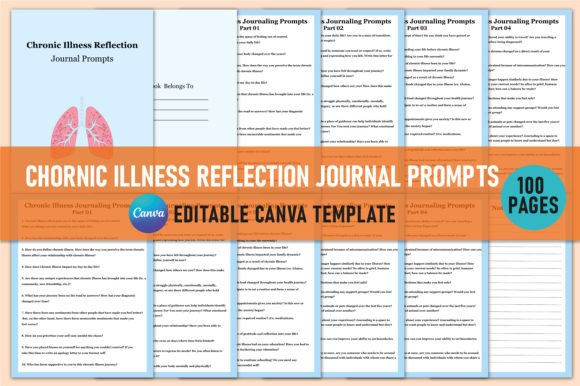
The Editable Chronic Illness Reflection Journal Prompts For Canva format adds a layer of practical utility. Because the prompts come as an editable Canva template (8.5 x 11 inches, 100 pages, 300 DPI, CMYK color, no bleed), you can customize the questions to match your specific condition, work context, and goals. This flexibility transforms a generic journal into a tailored strategy tool. Whether you prefer digital entries or print-ready PDF and JPG files, the format supports consistent use without friction.
Strategic Use Cases: Beyond Personal Journaling
Most people who encounter chronic illness prompts think of them as a way to process emotions or track symptoms. While that is a valid use, the strategic applications run deeper. Consider how reflection prompts can support specific professional and creative outcomes.
Goal Setting and Planning
Without clarity on your current state, goals are guesses. Reflection prompts help you establish a realistic baseline. For example, a prompt like “What energy level did I have this week, and how did it affect my progress on top priorities?” forces you to calibrate expectations. Over time, you learn to set goals that stretch you without breaking you. You also become better at sequencing work—tackling creative tasks during high-energy windows and leaving administrative work for lower-energy periods.
Brand Positioning and Communication
If you run a business or personal brand, your experience with chronic illness can become a source of authentic connection—or a liability if poorly communicated. Reflection prompts help you clarify your narrative. Questions such as “What aspect of my condition do I feel comfortable sharing with my audience, and why?” or “How does my health experience inform the value I offer?” enable you to craft messaging that feels honest and strategic rather than oversharing or performative. This is especially relevant for educators, coaches, and creators whose authority is tied to lived experience.
Creative Work and Content Production
Chronic illness often disrupts creative flow. Prompts that track your creative energy, idea generation, and output quality help you identify your most fertile conditions. You might discover that you write best in the morning after gentle movement, or that brainstorming works better when you are reclining rather than sitting at a desk. These insights allow you to design a creative practice that accommodates your body rather than fighting it.
Operational Decisions and Systems Design
For small business owners and freelancers, operational efficiency is everything. Reflection prompts can reveal bottlenecks caused by health fluctuations. A prompt like “Which part of my workflow required the most effort today, and could it be automated or delegated?” leads directly to process improvements. You might realize that client calls early in the week drain your energy for deep work, prompting you to reschedule them. Over time, your business systems become more resilient because they are built around your actual capacity, not an idealized version of productivity.
When and How to Use Chronic Illness Reflection Prompts
The timing and frequency of reflection matter as much as the content. Using prompts daily can feel burdensome, but using them randomly loses the strategic thread. A more effective approach is to align reflection with natural cycles in your work and health.
- Weekly reviews: Set aside 15–20 minutes at the end of each week to answer 3–5 prompts. Focus on what worked, what drained you, and what you want to adjust for the coming week. This cadence keeps insights fresh without overwhelming you.
- Project milestones: After completing a major deliverable—a product launch, a content series, a client engagement—use prompts to capture what you learned about your energy, focus, and decision-making under pressure. This builds a reference library for future projects.
- Health flares or transitions: When your condition shifts, reflection helps you recalibrate quickly. Prompts like “What do I need to deprioritize right now, and what is non-negotiable?” prevent you from pushing through a flare at the cost of longer recovery.
- Quarterly strategy sessions: Every three months, review your collected reflections to spot larger trends. Are you consistently overcommitting in certain areas? Are there recurring triggers that sap your productivity? This macro view informs your goals for the next quarter.
To approach reflection effectively, treat it as a structured conversation with yourself. Write in full sentences when possible, because the act of articulating thoughts forces clarity. If a prompt does not resonate, skip it or rephrase it. The goal is not to complete every question but to extract usable insights.
What to Consider Before Relying on Reflection Prompts
Reflection is a powerful tool, but it is not a panacea. Without clear goals or context, journaling can become circular—rehashing the same frustrations without leading to change. To avoid this, enter each reflection session with a loose intention. Ask yourself: “What decision do I need to make this week, and how might reflection help me make it better?”
Another risk is over-analyzing symptoms or emotions to the point of anxiety. If you find that reflection makes you hypervigilant about your health, dial back the frequency or shift the focus toward action-oriented prompts. The purpose is not to dwell on what hurts but to understand what helps.
Finally, reflection prompts are only as valuable as your willingness to act on what surfaces. It is easy to identify that you need to delegate more, say no to certain projects, or restructure your day—but implementing those changes requires discipline. Treat your reflections as commitments to yourself. When you write “I need to reduce screen time after 8 PM,” follow through as if it were a client deadline.
Practical Examples Using the Editable Canva Template
The Editable Chronic Illness Reflection Journal Prompts For Canva product includes four parts of prompts (Part 1–4) across 100 pages, giving you substantial material to work with. Here are a few examples of how to adapt the prompts for strategic use.
Example 1: Energy audit for content planning.
A prompt from Part 1 might ask: “What time of day did I have the most energy, and what task did I accomplish?” Record this for two weeks. You will likely see a pattern. If your peak energy occurs between 10 AM and 12 PM, schedule your most demanding content creation—writing, recording, designing—during that window. Move low-energy tasks like email or scheduling to the afternoon. This simple adjustment can increase output without working longer hours.
Example 2: Boundary setting for client work.
A Part 2 prompt might read: “What commitment did I make this week that I regretted, and why?” Use this to identify the types of requests that consistently lead to overextension. If you notice a pattern of agreeing to rush projects or unpaid consultations, create a policy: a minimum lead time for custom work, or a paid discovery call. Write that policy into your business operations guide.
Example 3: Creative flow tracking.
Part 3 includes prompts about moments of inspiration. “When did an idea come to me effortlessly, and what was I doing?” Track these moments. You may find that ideas surface during gentle walks, while showering, or after a short nap. Build a routine that protects those activities instead of treating them as optional. Creativity becomes more reliable when you design for it.
How to Use Chronic Illness Reflection Prompts Intentionally
Intentional use means knowing why you are reflecting and what you want to gain. Start by defining one or two outcomes you care about most. It could be improving your weekly output, making better decisions about which projects to pursue, or reducing the frequency of burnout cycles. Then select prompts that align with those outcomes.
Keep a master document—a spreadsheet or a section in your notes app—where you transfer key insights from your reflection sessions. Over time, this becomes a reference you can consult when making decisions. For example, before accepting a speaking engagement, you could look back at past reflections to see how travel and public appearances affected your energy. That data prevents you from making the same mistake twice.
Another intentional practice is to pair reflection with planning. After answering prompts, spend five minutes writing one concrete action you will take based on what you learned. If the insight is “I felt overwhelmed by too many open loops,” the action might be “I will close three small tasks before starting anything new tomorrow.” This closes the loop between reflection and execution.
Risks of Using Reflection Prompts Without Clear Goals
Without a strategic frame, reflection prompts can lead to a few common pitfalls. The first is analysis paralysis. If you reflect without translating insights into decisions, you accumulate observations without making progress. The second is emotional spiraling. Prompts that focus heavily on pain, limitation, or frustration can amplify negative feelings if not balanced with forward-looking questions. The third is inconsistency—reflecting intensely for a week then abandoning the practice, which destroys the longitudinal data that makes reflection so valuable.
To mitigate these risks, keep your reflection sessions time-boxed and focused. Use prompts that balance awareness with action. And commit to a minimum cadence—once a week for twelve weeks—before evaluating whether the practice is working. A single session rarely yields a breakthrough, but a dozen sessions, examined together, can change how you run your life and work.
Long-Term Value for Entrepreneurs, Creators, and Professionals
The professionals who benefit most from chronic illness reflection prompts are those who cannot afford to waste energy on guesswork. When your physical capacity is variable, every decision about how to spend that capacity carries weight. Reflection turns that constraint into a competitive advantage. You learn to prioritize with precision, communicate with honesty, and design systems that accommodate reality rather than fiction.
For entrepreneurs, this means fewer failed launches due to burnout. For creators, it means a more sustainable content practice. For educators and coaches, it means modeling resilience without martyrdom. And for anyone who leads a team or manages client relationships, it means showing up consistently because you have planned for inconsistency.
The Editable Chronic Illness Reflection Journal Prompts For Canva product—with its 100 pages, editable link, and multiple file formats (PDF, JPG, PNG)—gives you the raw material to build this practice. But the real value lies in how you use it. Treat the prompts as a diagnostic tool, a planning companion, and a decision log. The pages will fill with your patterns, your breakthroughs, and your adjustments. Over time, you will have not just a journal, but a strategic asset that helps you navigate chronic illness with skill rather than suffering.
Reflection is not a cure. It is a compass. Used intentionally, chronic illness reflection prompts help you set a direction that respects your limits while advancing your goals.