Dots and Boxes Interior for KDP Vol-18: Bridging Classic Gameplay and Thoughtful Book Design
Few pencil-and-paper games have endured as gracefully as Dots and Boxes. The rules are deceptively simple: two players take turns connecting adjacent dots with horizontal or vertical lines. Each time a player completes the fourth side of a 1×1 square, they claim that square and earn an extra turn. The player who captures the most squares when the grid is full wins. Yet beneath this straightforward premise lies a game rich with strategic nuance, spatial reasoning, and quiet psychological tension. For publishers, educators, and game enthusiasts, transforming this analog classic into a carefully formatted book product requires more than just printing grids. The Dots and Boxes Interior for KDP Vol-18 represents a deliberate approach to packaging this experience in a format that is immediately usable, professionally structured, and adaptable to different contexts.
The Anatomy of a Well-Structured Game Book
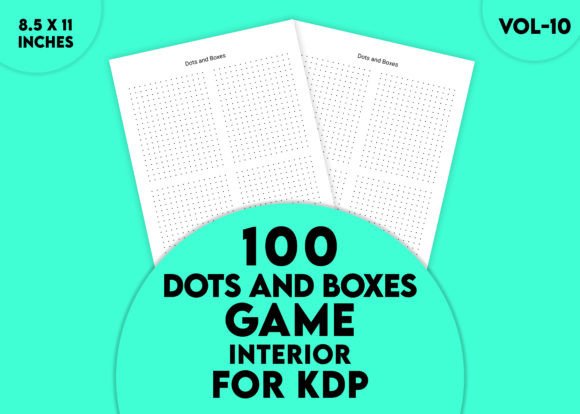
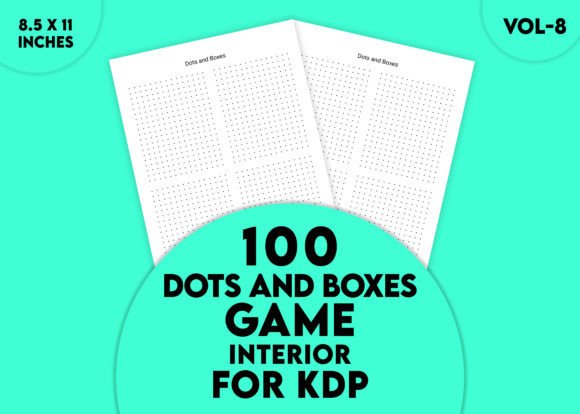
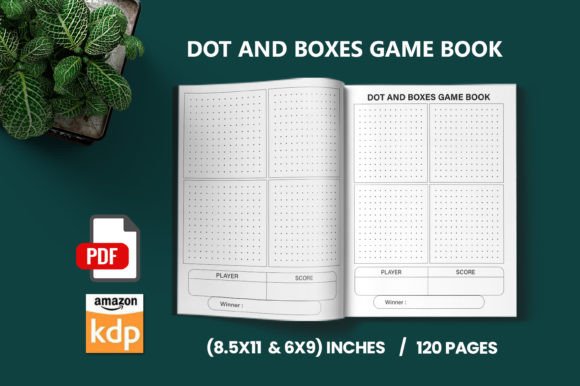
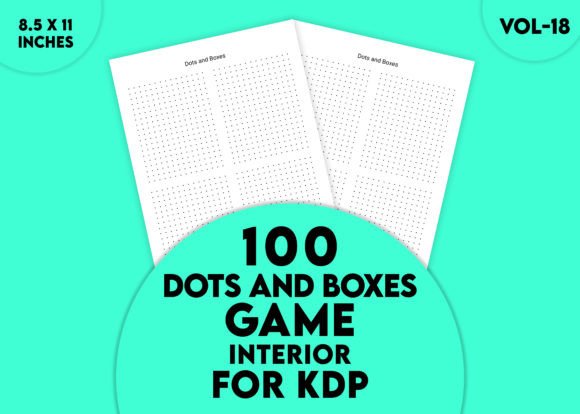
A game book lives or dies by its layout. When every page must serve both as a functional playing field and as a durable, easy-to-use surface, the interior design becomes paramount. The Dots and Boxes Interior for KDP Vol-18 is built around a standard 8.5 × 11 inch letter-size page, a format that offers generous room for gameplay without requiring oversized or unwieldy dimensions. This size is particularly appropriate because it accommodates the hand movements of both children and adults, provides enough space for players to draw lines cleanly, and allows the book to sit flat or be easily held during travel or casual play. The 100 pages of content—featuring 4 games per page—means that a single volume offers 400 individual rounds of play. This quantity is substantial enough for sustained use over weeks or months, whether in a classroom, a family setting, or a solo practice environment for those looking to improve their strategic play.
Why Four Games Per Page Works
The decision to place four games on each page is not arbitrary. A single grid per page can feel sparse and wasteful, especially in a book format where paper cost and thickness matter. Conversely, cramming too many grids onto a page can make lines difficult to draw, especially for younger players or those with less precise motor control. The four-per-page layout strikes a balance: each grid is large enough to allow comfortable line drawing and clear visibility of the dot matrix, while still offering the player multiple fresh games on a single sheet. This arrangement also encourages natural progression—players can complete a game, note the score in the margin or on the side, and move immediately to the next grid without flipping pages. For tournament-style play or classroom rotations, this density is practical and efficient.
Strategic Depth and the Appeal of Repeated Play
Dots and Boxes is often introduced as a children's game, but its strategic layers reveal themselves with repeated play. Novices tend to fill lines randomly or reactively, only to find themselves forced into giving away chains of squares. Intermediate players learn to recognize double-cross opportunities, where sacrificing a small number of squares can secure a larger chain later. Advanced players think several moves ahead, anticipating how the grid will break into regions and using the parity of the turn order to control the endgame. A book like the Dots and Boxes Interior for KDP Vol-18 supports this learning curve because the repetitive format encourages practice. Having 400 games at hand means a player can systematically explore opening strategies, experiment with different board regions, and track their improvement over time. Parents and educators often observe that children who play regularly develop stronger visual-spatial reasoning and a more intuitive grasp of turn-based tactics.
Observing the Learning Arc in Practice
In a classroom or family setting, the arc of skill development is tangible. Early games are short and often lopsided. After a dozen rounds, players begin hesitating before placing lines, mentally simulating consequences. By fifty games, many players develop personal heuristics: avoid starting a chain on your own turn, claim squares only when forced, and watch for the opponent's vulnerable regions. A dedicated game book with consistent formatting removes friction from this process. The player does not need to redraw grids, estimate dot spacing, or worry about uneven layouts. The grids are pre-measured, clean, and identical, allowing the mind to focus entirely on strategy. This consistency is one of the most underappreciated features of a professionally designed interior.
Editable PDF Ready: Practical Implications for Creators and Users
One of the defining features of this interior design is that it is delivered as an editable PDF file. For a publisher or content creator using Amazon KDP, this offers significant flexibility. The PDF can be used as-is for a print-ready book, but it can also be modified—perhaps to change the trim size slightly, add custom branding, include rule pages in different languages, or annotate grids with instructional notes. For teachers and tutors who purchase the book, the editable format (when accessed through compatible software) allows them to populate pages with pre-drawn examples, answer keys for puzzle variants, or custom scoring areas. The term "editable" here implies that the file is not locked or flattened; text fields, page numbers, and possibly even grid elements can be adjusted. This is particularly valuable for users who want to repurpose the content for digital whiteboards, projection slides, or interactive PDFs for remote learning.
Considerations When Working with Editable Game Grids
However, editable PDFs also come with certain considerations. Users need appropriate software to take full advantage of editability—Adobe Acrobat Pro or similar tools. Some free PDF readers will display the file correctly but will not allow modifications. Additionally, maintaining alignment after edits requires care; shifting a grid line or resizing a page can distort the spacing if the underlying structure is not preserved. For most users, the straightforward path is to use the PDF in its default state, which is already optimized for print and play. The editable capability is best understood as a bonus for those who have specific customization needs, rather than a required feature for everyday use. From a publishing standpoint, offering an editable file can reduce returns and increase customer satisfaction because buyers feel they have control over the final product.
Who Benefits from a Dots and Boxes Game Book
The audience for a thoughtfully designed Dots and Boxes book is broader than one might initially assume. The following groups each find distinct value in the format:
- Parents and caregivers seeking screen-free activities that are portable and require no setup. A game book fits in a backpack or purse and provides immediate entertainment during travel, waiting rooms, or quiet evenings at home.
- Classroom teachers looking for quick, low-prep games that reinforce logical thinking, turn-taking, and fine motor skills. The four-per-page layout means a single sheet can serve multiple student pairs, reducing paper usage.
- Homeschooling families who integrate game-based learning into their curriculum. Dots and Boxes can be used to teach pattern recognition, basic probability, and the concept of optimal moves within constraints.
- Game enthusiasts and hobbyists who enjoy analyzing combinatorial games. A large collection of grids allows for systematic exploration of openings and endgame scenarios.
- KDP publishers and content creators who need a reliable, tested interior template for volume production. The consistent formatting and standard trim size reduce the risk of printing errors and customer complaints.
- Therapists and occupational specialists who use drawing and tracing activities to develop hand-eye coordination. The structured dot grid provides a clear, repeatable target for line-drawing exercises.
Layout Characteristics That Enhance Playability
Beyond the raw numbers, the fine details of the interior design matter greatly. Dot size and spacing must be calibrated so that lines drawn between them are unambiguous—too close together and the grid becomes cramped; too far apart and lines may waver. The 8.5 × 11 inch format allows for generous margins, which are not merely aesthetic. Margins give players a place to rest their hand without smudging previous lines, to note scores or player names, and to clip the book open without entering the grid area. The use of four games per page also means that each grid can be arranged symmetrically, creating a clean visual rhythm that reduces cognitive load. Players do not have to search for the next game; the layout is predictable. This predictability is especially important for younger players, who benefit from routine and clarity in their activity materials.
Observing Real-World Use Patterns
When observing groups playing from a well-designed book, one notices certain behaviors. Players often start with the grid in the top-left corner of the page, working their way across and down. This systematic consumption of the page is natural—it mirrors reading direction in left-to-right languages. Some players prefer to play multiple games simultaneously on the same page, switching between grids as strategies occur to them. The four-per-page layout supports this without confusion, because each grid is clearly bounded and separated by space. After completing a page, there is a small sense of accomplishment, a tangible milestone that digital games often lack. The physical act of turning the page and seeing a fresh set of four empty grids is itself motivating. This psychological pacing is something that a well-constructed interior design facilitates without conscious effort.
Durability and Practical Considerations for a Printed Game Book
A Dots and Boxes book receives more physical handling than a typical novel or reference work. Pages are drawn on, pressed flat, and sometimes erased or crossed out. The paper quality must tolerate pencil or pen without excessive bleeding or tearing. While the interior design file does not control paper stock—that is determined by the printer and the trim size—the layout can alleviate some stress on the binding. With 100 pages and a standard letter size, the book is thick enough to feel substantial but not so thick that it cannot lay flat. The grid placement within safe printable margins ensures that no gameplay area is lost to the binding gutter. For self-publishers using KDP, testing a physical proof copy is highly recommended to verify that the margins are appropriate for the chosen paper type. The Dots and Boxes Interior for KDP Vol-18 is designed with these printing realities in mind, but slight adjustments may be needed depending on the specific printer's requirements.
Digital Versus Print: Complementary Use Cases
An interesting trend in recent years is the use of game interiors in both print and digital forms. Some users purchase the book in print for tabletop play, then use the editable PDF on a tablet with a stylus for travel or online play with distant friends. The consistent grid size across both formats allows seamless switching. A teacher might project the PDF on a smartboard while students use printed copies at their desks. This cross-format utility is increasingly valued by modern consumers, who do not necessarily see print and digital as competing options. The editable PDF format bridges the two worlds effectively, provided the file is optimized for both screen rendering and print resolution.
Final Observations on Game Book Design Philosophy
Designing a game book interior is not simply about putting grids on a page. It is about anticipating how human hands and minds will interact with the physical object over the course of hundreds of games. Every decision, from the page size to the number of games per page to the editability of the file, shapes the user's experience. The Dots and Boxes Interior for KDP Vol-18 reflects a careful balancing of density, clarity, and flexibility. It acknowledges that the same book might be used by a six-year-old learning to draw straight lines, a teenager refining their competitive strategy, a teacher managing a classroom activity, and a publisher building a catalog of activity books. Few products serve such a wide range of users without compromising on quality, but a well-considered interior design makes that possible. The game itself has remained popular for over a century because it is elegant and deep. The book that contains it deserves the same respect for thoughtful structure and usability.